
Does Exercise Variety Actually Build More Muscle?
What a 10-Week Study Reveals About Programming
In the fitness world, exercise variety is often treated like a requirement for muscle growth.
You’ll hear things like:
“You have to hit different angles”
“Your muscles adapt too quickly”
“You should never repeat the same workout”
But what if that advice is… unnecessary?
A recently published resistance training study gives us a clear answer.
The Study Overview
Researchers investigated whether constantly changing exercises leads to greater muscle growth and strength compared to repeating the same exercises over time.
📄 Full study available here:
👉 https://pubmed.ncbi.nlm.nih.gov/39388663/
Participants
70 young women
Average age: ~22 years
Completed a 10-week resistance training program
Training Structure
3 training sessions per week
2 working sets per exercise
10–15 reps to near failure
Lower-body focused training
Outcomes Measured
Muscle thickness of the thigh (ultrasound, multiple sites)
Strength via 1RM testing (including a non-trained exercise)
How the Programs Were Designed
Constant Resistance Group (CON)
This group performed the same two exercises every session:
Leg Press
Stiff-Leg Deadlift
No weekly rotation. No novelty. Same movements across all training days.
Varied Resistance Group (VAR)
This group rotated exercises throughout the week:
Day 1
Leg Press
Stiff-Leg Deadlift
Day 2
Hack Squat
Prone Leg Curl
Day 3
Smith Machine Squat
Seated Leg Curl
More exercise variety. More machine changes. More perceived “angle work.”
The Results (This Is the Important Part)
After 10 weeks, both groups experienced nearly identical adaptations.
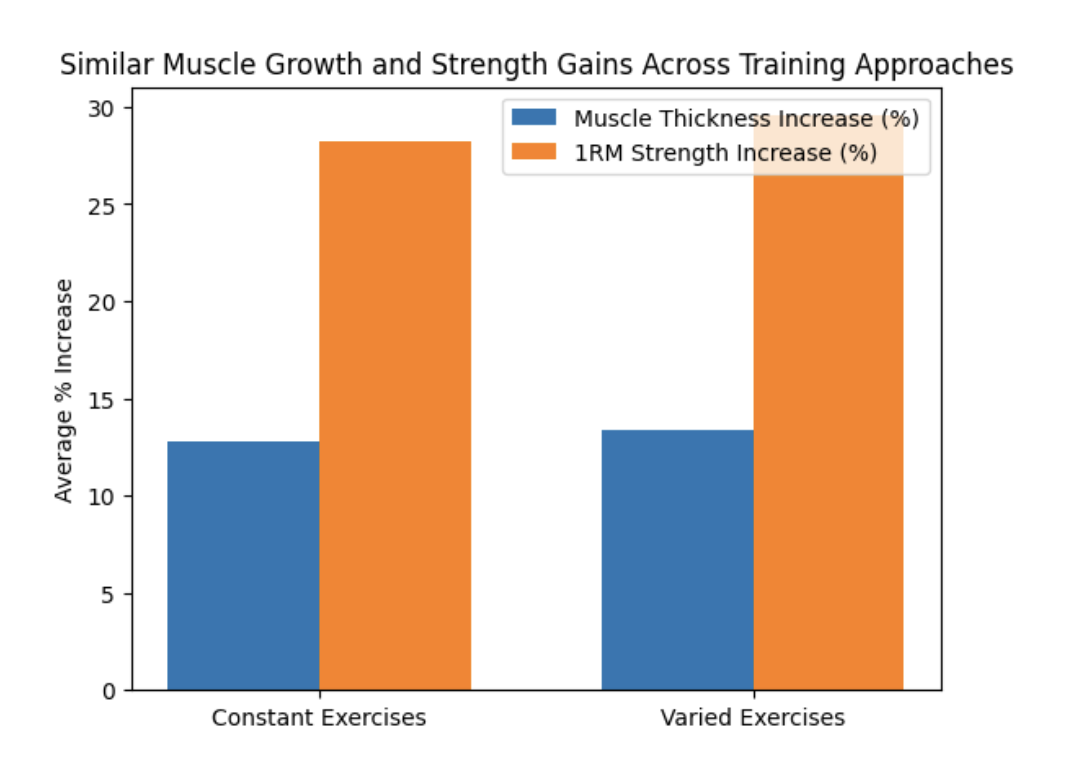
Muscle Thickness Increases
Constant group: ~7.8–17.7%
Varied group: ~7.5–19.3%
Strength Gains
Constant group: ~24–32%
Varied group: ~29–30%
There were no statistically significant differences between groups for muscle growth or strength.
Repeating exercises did not limit hypertrophy or strength development.
What This Actually Means for Your Training
This study reinforces a principle that often gets lost in modern programming:
Muscles respond to stimulus — not novelty.
As long as:
Volume is sufficient
Sets are taken close to failure
Progressive overload is present
Your muscles do not care whether the movement is a leg press, hack squat, or Smith squat.
Key Takeaways for Smarter Programming
1. Repeating exercises is not a mistake
Just because you trained an exercise on your “A day” doesn’t mean you can’t do it again on your “B or C day.”
If an exercise:
Feels good on your joints
Has a high stimulus-to-fatigue ratio
Allows consistent loading and progression
Repeating it is often the best choice.
2. “Hitting different angles” is not a growth shortcut
Exercise variation can be useful, but it’s not inherently superior.
This study shows that rotating exercises does not produce greater muscle growth when volume and effort are matched.
Angle-chasing often distracts from the real drivers of hypertrophy.
3. Variety is optional — adherence is not
If you enjoy variety and it keeps you consistent, that’s fine.
But if you:
Have a few staple lifts you enjoy
Execute them well
Can progressively overload them
You are not leaving gains on the table by sticking with them.
How We Apply This at Aspire Fit
At Aspire Fit, programming is built around:
A small pool of high-quality exercises
Enough time with each movement to actually progress
Strategic changes only when needed — not out of fear or boredom
Exercises are changed when:
Progress stalls
Recovery becomes an issue
Joint tolerance changes
Not because novelty feels productive.
The Bottom Line
You don’t need:
Endless exercise variation
Weekly workout overhauls
Fancy angles
You need:
Smart exercise selection
Adequate volume
High effort
Consistent progression
This study confirms what good coaching already knows:
Consistency builds muscle. Variety is optional.
📚 Reference
Effects of varied versus constant resistance training on muscular adaptations in young women.
PubMed ID: 39388663
https://pubmed.ncbi.nlm.nih.gov/39388663/