
How to Add 100+ lbs to Your Bench Press: The Science-Based Progression Guide
If your bench press has been stuck at the same weight for months, or even years, you are not alone. Most guys are just going through the motions at the gym, doing 3 sets of 10 every Monday, hoping that somehow, magically, they’ll get stronger next week. But unfortunately, that is not how human physiology works. If you want to be strong and build a chest that looks the part, you have to stop guessing and start programming. In this article we’re going to break down the science of strength and hypertrophy progression for the bench press.
1. The Foundation: Progressive Overload
Progressive overload is the absolute non-negotiable for muscle growth and strength. If you do not give your body a reason to adapt, it will not.
You can implement progressive overload multiple ways, as long as you’re increasing the overal stimulus over time; that’s what matters. You can increase intensity, load, reps, and volume, and improve technique, and so on and so forth.
A 2024 study in the International Journal of Sports Medicine directly compared progressing by adding weight (load progression) versus progressing by adding reps with the same weight (rep progression). The researchers found that both methods significantly increased 1-rep max (1RM) strength and muscle cross-sectional area over 10 weeks, with no difference between the two [1].
For my clients, I typically like to start with a simple double linear-based progression, increasing reps first followed by weight second.
2. Rep Ranges: The Strength vs. Hypertrophy Continuum
For decades, we were taught that 1-5 reps were exclusively for strength, and 8-12 reps were exclusively for hypertrophy (muscle growth). A landmark 2021 review in Sports (Basel) completely re-examined this "repetition continuum." The researchers found that muscular adaptations can be obtained across a wide spectrum of loading zones (anywhere between 5-30 reps) [2].
Heavy loads (1-5 reps) do optimize maximal strength gains better than moderate loads, primarily due to neural adaptations. However, hypertrophy can occur equally well across heavy, moderate, and even light load ranges, provided the sets are taken close to muscular failure. If you want a strong bench press, you need to spend time in the heavy 1-5 rep range to train your nervous system and improve max strength, but you also need moderate-rep volume to build the actual muscle tissue that moves the weight.
3. Periodization: Why Doing the Same Thing Kills Progress
If you do 3 sets of 10 every single week, eventually you’ll hit a plateau where you’re not able to progress as fast (especially as you stop being a beginner lifter. This is where periodization comes in. Periodization is simply the planned variation of training variables (like volume and intensity) over time.
A 2022 meta-analysis published in Sports Medicine found that periodized training produced significantly greater 1RM strength gains than non-periodized training [3]. Furthermore, undulating periodization (changing the rep ranges week-to-week or even day-to-day) produced greater strength gains than linear periodization (slowly dropping reps over several months), especially in trained individuals [3]. Varying your rep ranges forces your body to constantly adapt to new stimuli.
4. Volume: How Many Sets Do You Actually Need?
Let’s go over how much you should bench. On social media, this is a highly debated topic between the high-volume and low-volume camps. A 2022 systematic review in the Journal of Human Kinetics analyzed the effects of different training volumes on muscle hypertrophy. They concluded that 12 to 20 weekly sets per muscle group is the optimal standard recommendation for maximizing hypertrophy in trained individuals [4].
5. Rest Periods: Stop Rushing Your Sets
We have all been told to keep our rest periods strictly between 60 and 90 seconds to "keep the heart rate up" or maximize the pump. If your goal is maximal strength and hypertrophy on a compound lift like the bench press, that advice is dead wrong.
A 2016 randomized controlled trial published in the Journal of Strength and Conditioning Research compared 1-minute rest intervals to 3-minute rest intervals in experienced lifters. The group resting 3 minutes saw significantly greater increases in both 1RM bench press strength and muscle thickness [5]. When you rest longer, your nervous system recovers, allowing you to lift heavier weights for more reps on subsequent sets. That increased mechanical tension is what drives growth. Take upwards of 2-3 minutes or more between sets so you’re fully ready to go between your heavy bench press sets.
6. Range of Motion: Every Rep Counts
Finally, let us talk about the guys doing half-reps with three plates on the bar. A 2023 systematic review in the International Journal of Strength and Conditioning confirmed that using a full or long range of motion enhances results for strength, muscle size, and power compared to partial range of motion [6]. While partials have a place for advanced lifters working on specific sticking points, the foundation of your strength must be built on full range of motion reps; that means touching the chest and locking out completely.
The Aspire Method Bench Press Blueprint
If you want to put this science into practice, here is a simple bench press progression to run for the next 12 weeks:
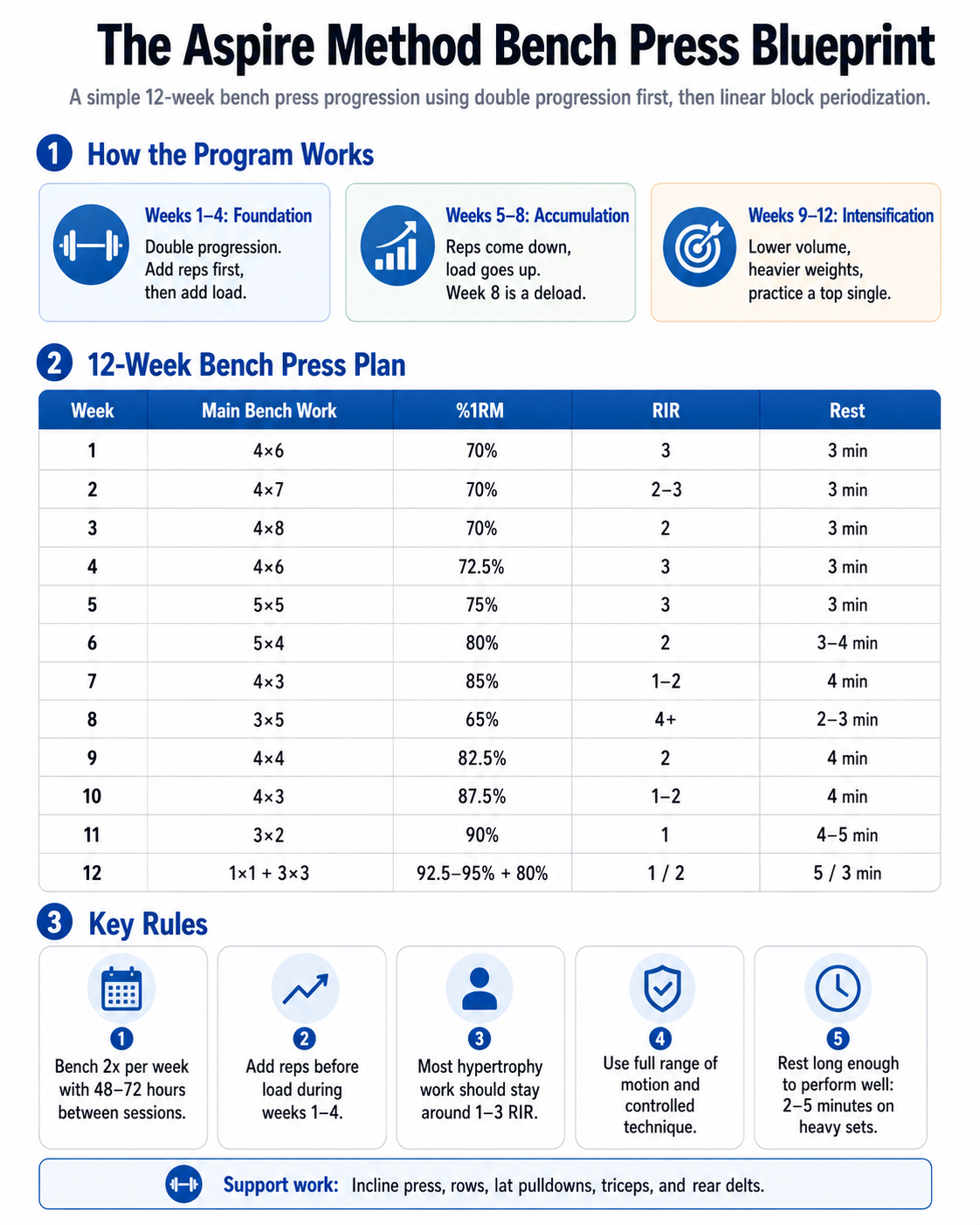
If you are sick and tired of trying to figure this all out again on your own, and want an expert team to guide you along the way to help you lose anywhere from 10-50+ lbs of body fat, add lean muscle mass, and finally go to the gym with a clear game plan and strategy, book a 1:1 strategy call with me below. 👇🏼
Book your 1:1 coaching strategy call with Aspire Fit here!