The Best Bicep Exercises: What Anatomy and Science Say About Building Bigger Arms
If you want to build bigger arms, Bicep training is going to be one of the main things you’ll want to focus on. I don’t think I’ve ever run into a person who thought their biceps weren’t big enough. In this article, I’ll be breaking down step by step how to train your biceps effectively so you can get the most out of your training sessions.
What are the Biceps & what do they Do?
The biceps brachii or better known as the biceps, sits on the front of your upper arm and crosses both the shoulder and elbow [1]. Its main jobs are to turn the palm upward, a motion called supination, and to bend the elbow. This is why a palm-up-based curl variation should be one of your staples (more on that in a minute).
The muscle has a long head (inside) and a short head (outside). Both the long and short heads originate from the scapula (shoulder blade), the long head originates on the supraglenoid tubercle, whereas the short head originates from the coracoid process.
Due to the anatomy of the biceps the long head helps contribute a little bit to shoulder flexion aka raising your arm upward.
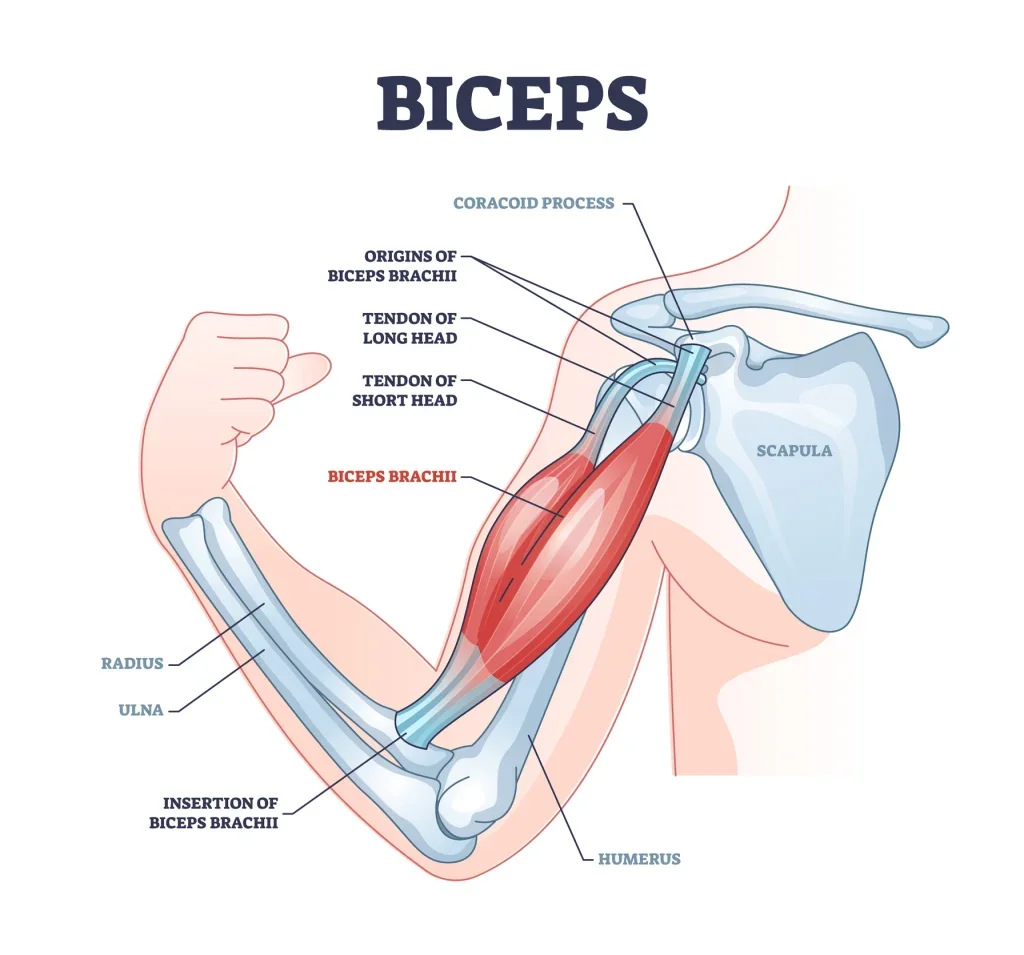
There a few other muscles worth noting, like your brachialis and your brachioradialis as well. Both of these muscles help bend the elbow (flex the arm) in addition to the biceps.
Do Different Curls Grow Different Parts of the Biceps?
A study in the International Journal of Environmental Research and Public Health had 35 young adults train preacher curls three times per week for 10 weeks [2]. One group used a cable setup that was hardest near the top. The other used a barbell that was hardest closer to the bottom. Biceps thickness increased by 7% and 8%, respectively, with no meaningful difference between groups [2].
A newer study compared preacher curls, where the arms are in front of the body, with Bayesian cable curls, where the arm is held behind the body. Fifteen young men trained one variation with each arm twice per week for 10 weeks.
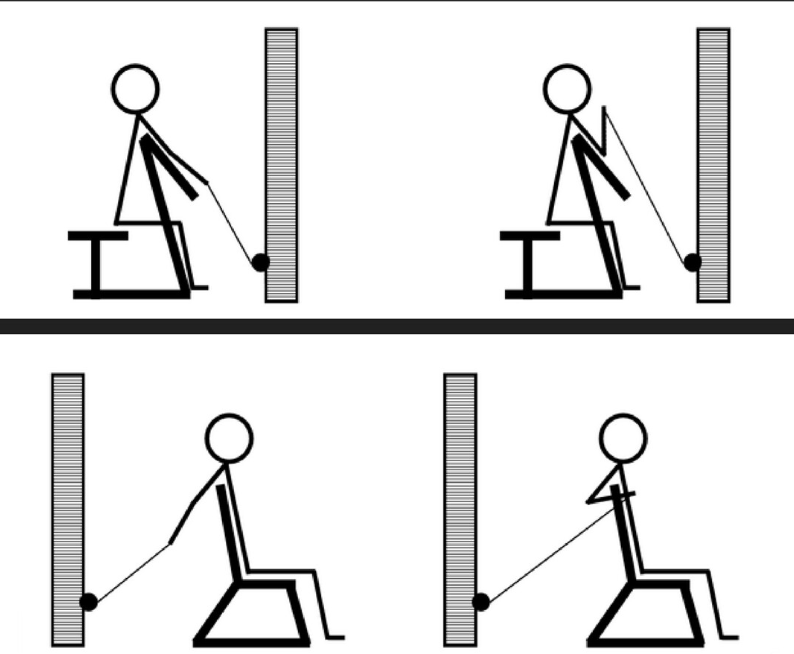
Figure from - https://onlinelibrary.wiley.com/doi/10.1002/ejsc.12279
When resistance profiles were matched, biceps growth and strength gains were similar [3].
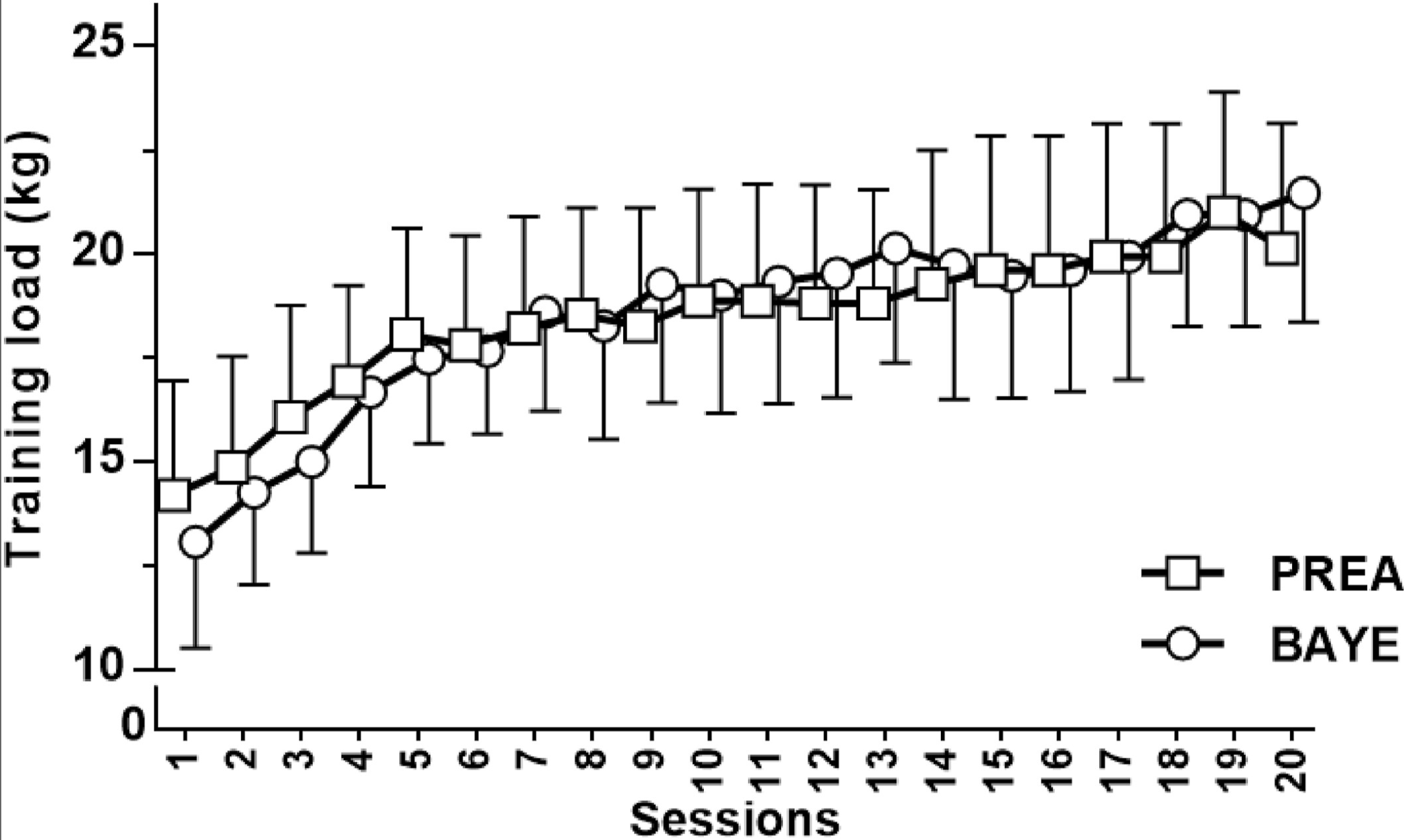
Figure from - https://onlinelibrary.wiley.com/doi/10.1002/ejsc.12279
Which one is the best bicep exercise?
The best bicep exercise is the one you can perform with a full range of motion, good technique, and progressive overload.
Grip changes how your arm muscles share the work. In a laboratory study, a palms-down grip increased the activity of the brachioradialis (that’s the outer muscle in your forearm) compared with neutral and palms-up grips [4].
What this means for your program: Use a palms-up curl as a main movement. Add hammer curls and pronated curls will work other muscles in the arm and forearm, but will not significantly grow the biceps. Choose preacher curls, Bayesian curls, cables, barbells, or dumbbells based on comfort and equipment access
Technique: How to Make a Curl Train Your Biceps
Good technique is not about making every repetition look identical on video. It is about keeping the target muscle under useful tension while avoiding unnecessary momentum.
SEt up
Keep your elbow near the position intended by the exercise. Do not let it drift dramatically forward just to finish the curl.
Use a full range of motion.
Lower the weight until your elbow is close to straight; a lockout isn’t necessary, but if you’re working on standardizing your reps, you can flex your triceps at the end of the rep to ensure you fully extended your arm. Then curl as far as you can while keeping your wrist supinated and while keeping the shoulder down.
Make the lowering phase deliberate.
You do not need an exaggeratedly slow tempo, but do not drop the weight. Stay in control from the top back to the starting position.
Choose a load you can control.
If your torso rocks backward, your shoulders roll forward, or your wrists bend excessively, reduce the load or use a more stable variation.
These are practical coaching cues. They help you repeat good reps and track progress, but they are not a claim that there is one perfect curl technique for every body.
Should You Use a Full Range of Motion?
A systematic review reached a practical conclusion for this question: full repetitions and partials performed closer to the stretched position appear more useful for growth than top-half-only partials [6]. What this research supports: Full, controlled repetitions are a dependable default. What remains uncertain: The exact best range for every exercise is not settled, so do not force a deeper stretch than your joints tolerate.
How Much Biceps Training Do You Need?
Weekly volume is the number of challenging sets you perform for a muscle across the week. More weekly resistance-training sets are generally associated with more muscle growth, but recovery, technique, and effort still matter [7].
Frequency is mainly a scheduling tool. A meta-analysis found no meaningful hypertrophy advantage for a higher weekly frequency when weekly volume was matched [8]. Low, moderate, and high loads can all build muscle when sets are sufficiently hard, while higher loads improve maximal strength more [9, 10]. Training to momentary failure is not required [11]
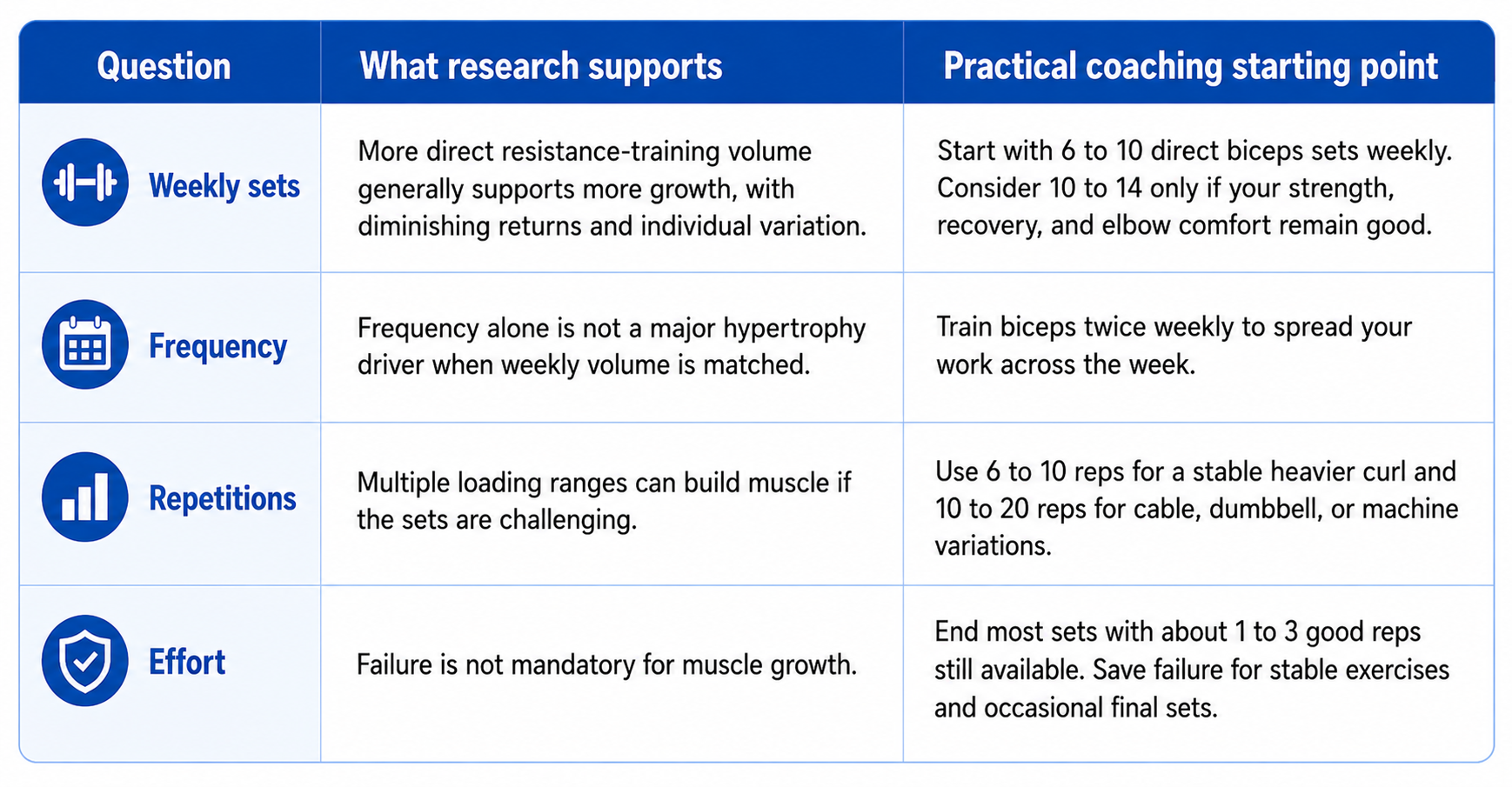
The right side of this table is a coaching recommendation, not a universal scientific law. If your elbows become irritated or your performance stalls for several sessions, do not automatically add more volume. First, look at your technique, sleep, nutrition, total pulling volume, and exercise selection.
A Simple Two-Day Biceps Workout
This template gives you 10 direct biceps sets per week. Pair it with your normal pulling work, but keep your direct curls high quality. If your back workout leaves your biceps too fatigued to use good technique, perform at least some direct arm work on a different day.
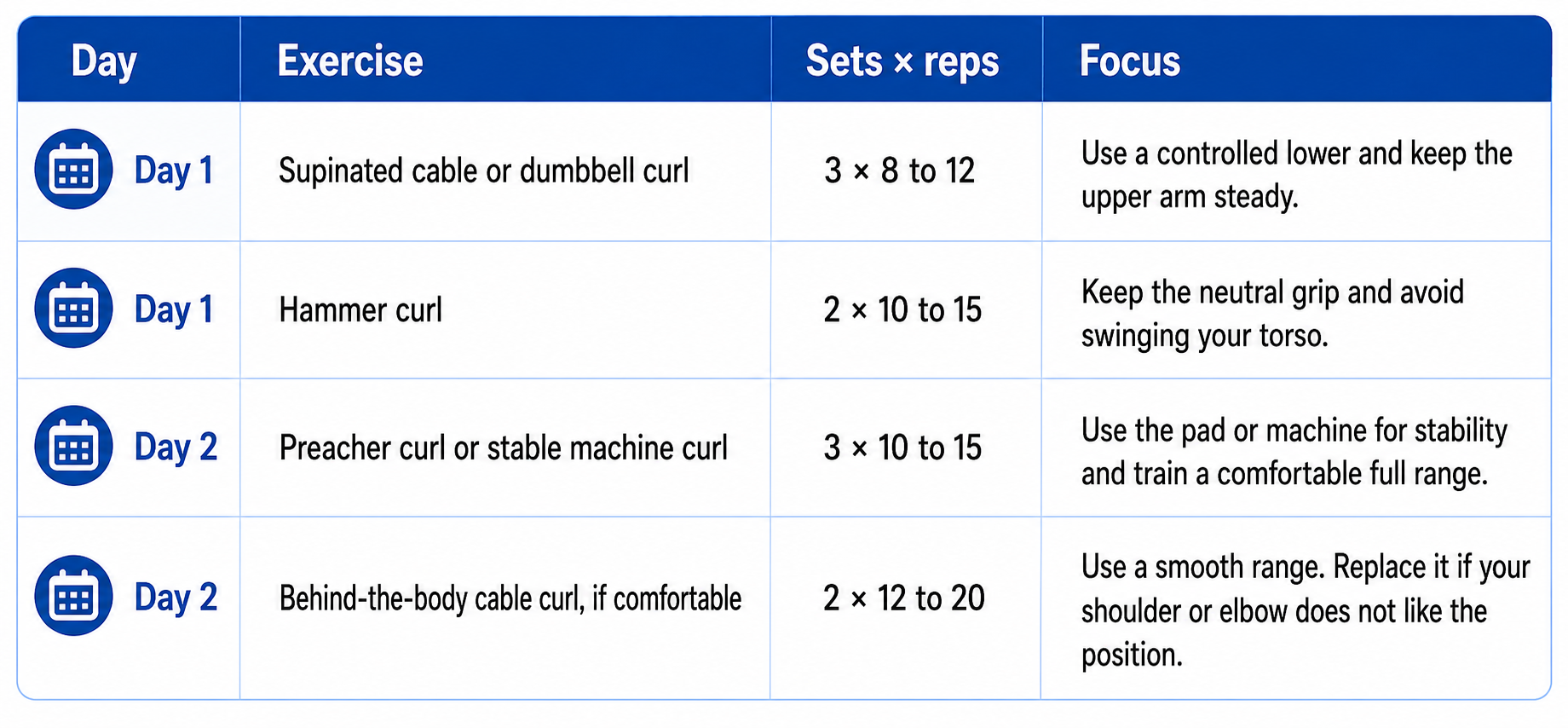
How to Progress the Plan for Four to Six Weeks
Start week 1 with loads that allow you to finish each set with about two good repetitions in reserve. Record the load and every completed repetition.
Across weeks 2 through 4, use double linear progression. Keep the same weight until you can complete the top of the repetition range on every working set with clean form. For example, with 3 sets of 8 to 12 reps, progress from 10, 9, 8 reps to 12, 12, 12 reps over several sessions. Then increase the load by 2.5-10 lbs and work back up from the lower end of the range.
In weeks 5 and 6, keep progressing if your joints feel good and your performance is moving forward. If you have stalled for two or more sessions, do not rush to add exercises. First, hold the same load for another week, reduce a few sets if fatigue is high, or switch to a more comfortable curl variation. The goal is steady progress you can repeat, not a single perfect workout.
Want to take your training to the next level?
Now, if you are ready to stop going through the paces and start seeing real results, you can schedule a coaching strategy call with us today. If we are a good fit for you and your goals, our team of experts will create a solid exercise plan that will take your bicep training to the next level.
Book your 1:1 coaching strategy call with Aspire Fit today.
📚 References
[1].Champlin, J., Porrino, J., Dahiya, N., & Smith, J. (2017). A Visualization of the Distal Biceps Tendon. PM&R, 9(2), 210-215. DOI: 10.1016/j.pmrj.2016.10.005.
[2].Nunes, J. P., Jacinto, J. L., Ribeiro, A. S., Mayhew, J. L., Nakamura, M., Capel, D. M. G., Santos, L. R., Coutinho, V., Cyrino, E. S., & Aguiar, A. F. (2020). Placing Greater Torque at Shorter or Longer Muscle Lengths? Effects of Cable vs. Barbell Preacher Curl Training on Muscular Strength and Hypertrophy in Young Adults. International Journal of Environmental Research and Public Health, 17(16), 5859. DOI: 10.3390/ijerph17165859.
[3].Attarieh, P., Nunes, J. P., Khani, S., Sabzevari, E., Cholewa, J. M., & Shirvani, H. (2025). Comparison Between Shoulder Flexed and Extended Positions in Elbow Flexion Resistance Training on Regional Hypertrophy and Maximum Strength: Preacher versus Bayesian Cable Curls. European Journal of Sport Science, 25(4). DOI: 10.1002/ejsc.12279.
[4].Kleiber, T., Kunz, L., & Dißelhorst-Klug, C. (2015). Muscular coordination of biceps brachii and brachioradialis in elbow flexion with respect to hand position. Frontiers in Physiology, 6, 215. DOI: 10.3389/fphys.2015.00215.
[6].Kassiano, W., Costa, B., Nunes, J. P., Ribeiro, A. S., Schoenfeld, B. J., & Cyrino, E. S. (2023). Which ROMs Lead to Rome? A Systematic Review of the Effects of Range of Motion on Muscle Hypertrophy. Journal of Strength and Conditioning Research, 37(5), 1135-1144. DOI: 10.1519/JSC.0000000000004415.
[7].Schoenfeld, B. J., Ogborn, D., & Krieger, J. W. (2017). Dose-response relationship between weekly resistance training volume and increases in muscle mass: A systematic review and meta-analysis. Journal of Sports Sciences, 35(11), 1073-1082. DOI: 10.1080/02640414.2016.1210197.
[8].Schoenfeld, B. J., Grgic, J., & Krieger, J. (2019). How many times per week should a muscle be trained to maximize muscle hypertrophy? A systematic review and meta-analysis of studies examining the effects of resistance training frequency. Journal of Sports Sciences, 37(11), 1286-1295. DOI: 10.1080/02640414.2018.1555906.
[9].López, P., Radaelli, R., Taaffe, D. R., Newton, R. U., Galvão, D. A., Trajano, G. S., Teodoro, J. L., Kraemer, W. J., Häkkinen, K., & Pinto, R. S. (2021). Resistance Training Load Effects on Muscle Hypertrophy and Strength Gain: Systematic Review and Network Meta-analysis. Medicine & Science in Sports & Exercise, 53(6), 1206-1216. DOI: 10.1249/MSS.0000000000002585.
[10].López, P., Radaelli, R., Taaffe, D. R., Newton, R. U., Galvão, D. A., Trajano, G. S., Teodoro, J. L., Kraemer, W. J., Häkkinen, K., & Pinto, R. S. (2022). Corrigendum: Resistance Training Load Effects on Muscle Hypertrophy and Strength Gain: Systematic Review and Network Meta-analysis. Medicine & Science in Sports & Exercise, 54(2), 370. DOI: 10.1249/MSS.0000000000002838.
[11].Grgić, J., Schoenfeld, B. J., Orazem, J., Sabol, F., & Pedisic, Z. (2022). Effects of resistance training performed to repetition failure or non-failure on muscular strength and hypertrophy: A systematic review and meta-analysis. Journal of Sport and Health Science, 11(2), 202-211. DOI: 10.1016/j.jshs.2021.01.007.